

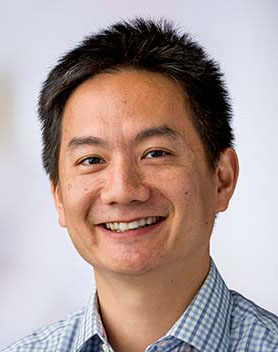

New ways to target triple-negative breast cancer cells

Dr. Kevin Cheung, associate professor (Hematology and Oncology) has received a V Foundation Translational Grant providing $800,000 over 4 years. Cheung will study new ways to target triple-negative breast cancer cells, so named because they lack estrogen receptors, progesterone receptors and sufficient levels of HER2 protein, which promote the growth of cancer cells. Research into new potential targets is crucial because the drugs used to treat hormone-receptor or HER2-positive breast cancers are not as effective for those with Triple-negative breast cancer (TNBC).
Triple-negative breast cancer occurs in up to 20% of all breast cancer patients, and can be highly aggressive, dividing more quickly and exhibiting increased resistance to standard cancer treatments such as chemotherapy.
TNBC is particularly difficult to treat because of the absence of obvious markers that could be targeted with existing hormone-specific cancer drugs. Without receptors for estrogen or progesterone inside the cell, or significant amounts of the protein HER-2 on the cell surface, TNBC cells are harder to treat than other breast cancer subtypes. It’s a predicament that keeps Cheung, the recipient of a V Foundation Translational Grant, up at night.
"I've been trying to understand how cancer cells, particularly breast cancer cells, metastasize,” Cheung said. "Metastatic cancer cells have the aggression dial turned way up, making them spread rapidly, seed different sites, and resist therapies. What if you could turn the aggression dial way down?"
This is Cheung’s second grant from the V Foundation. He previously received a 2017 V Scholar Grant for a project studying mechanisms of cancer metastasis. For his current project, Cheung is looking at molecular clues in cancers without obvious drug targets to take advantage of their cellular machinery to make them less aggressive.
While breast cancers identified by the presence or absence of hormonal receptors are known as “clinical subtypes,” these cancers can also be described based on their molecular or morphological characteristics, such as their shapes and how they act under certain conditions. These so-called “molecular subtypes” include one type of tumor commonly seen in TNBC: the presence of cancer cells that resemble basal epithelial cells, a type of cell normally seen in the epidermis, the top layer of human skin.
The idea that a triple-negative breast cancer cell could resemble an epidermal cell suggested to Cheung that perhaps these cells could be coaxed into acting like them as well. That could provide a new avenue for the treatment of TNBC, by tricking these cancer cells into acting like cells that routinely die instead of multiplying uncontrollably.
Cheung’s project, “Irreversible differentiation of triple-negative breast cancer via targeted UPS inhibition,” targets a class of proteins known as the ubiquitin-proteasome system (UPS). The UPS system degrades old proteins in cells and recycles their remnants to build new proteins inside the cell. It is a key mechanism in cellular biology that allows cells to survive and multiply.
Cheung believes that UPS inhibitors, drugs with FDA approval that are in common use for multiple myeloma, could be used to identify and kill basal-like tumor cells in TNBC. He plans to use his grant to conduct critical experiments that will help in the design of a clinical trial for patients whose TNBC has already been successfully treated, in the hopes that the basal-like tumor cells that could seed a relapse could be eradicated before causing a recurrence of the cancer.
He credits breast cancer oncologist Sara Hurvitz, MD, senior vice president and director of the Clinical Research Division, and myeloma oncology expert Andrew Portuguese, MD, an assistant professor in the Clinical Research Division, for helping him conceptualize how these drugs can be repurposed for therapeutic use in TNBC. Hurvitz holds the Smith Family Endowed Chair in Women’s Health.
“Once [TNBC cells] start acting like skin cells, they can't spread or grow,” Cheung wrote in his grant application. “This approach could stop TNBC before it comes back and becomes life-threatening.”
The implications for patients are substantial. Cheung notes that TNBC has the highest rate of relapse of all types of breast cancer within five years after the initial diagnosis. By the time a relapse is detected, many millions of TNBC cells will have already seeded the recurrence.
Cheung’s project will determine whether UPS inhibitors can drive TNBC cells to differentiate into basal-like cells, and whether these cells normally digest and degrade the proteins known as transcription factors that drive cells to differentiate into basal skin cells. From there, he plans to determine how to identify TNBC patients that could benefit from UPS inhibitor-based therapy to prevent a relapse of their cancer.
The planned clinical trial aims to treat TNBC patients in remission with UPS inhibitors in the hopes that these drugs will degrade basal-like cells that could otherwise proliferate and create new tumors. Cheung will work in collaboration with cancer epidemiologist Christopher Li, MD, PhD, senior vice president and director of the Public Health Sciences Division. Li holds the Helen G. Edson Endowed Chair for Breast Cancer Research.
“UPS inhibition has never been studied in the context of micrometastasis eradication [the eradication of small amounts of cancer cells before a diagnosable relapse occurs],” Cheung said. His hope is that by tricking basal-like cells into acting like skin cells that normally die off instead of proliferating uncontrollably, these studies will lead to a new class of treatments for cancer that look not at surface markers for drugs but cellular shapes and activities that can be disrupted.